





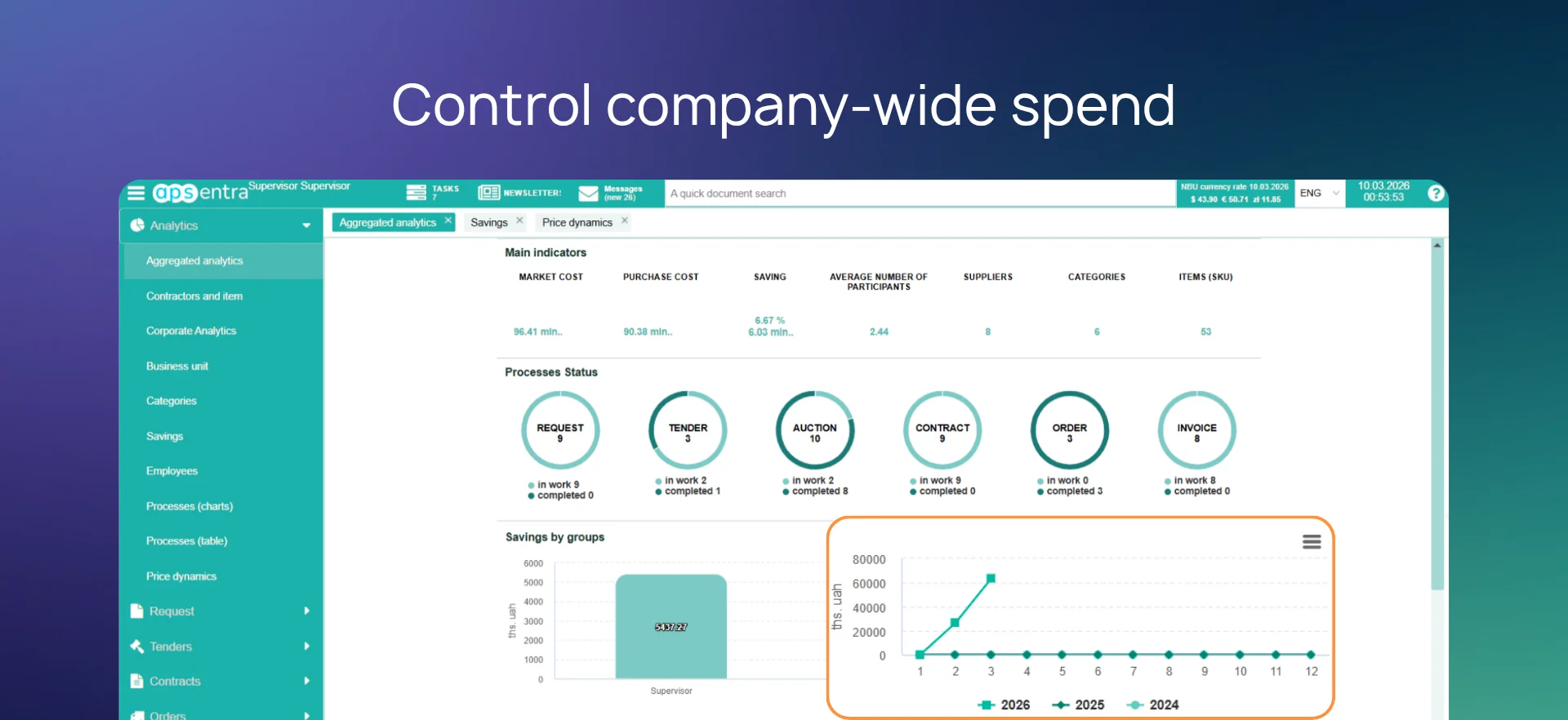
Built in Europe, trusted by 130+ enterprise clients, managing $129 billion in procurement spend — APSentra is now bringing its governance-first approach to the United States and Canadian markets, at a moment when North American organizations are realizing that fragmented procurement is costing them far more than they thought.
Europe has long understood that procurement is not a back-office function. The regulatory environment, the emphasis on audit readiness, the expectations around supplier traceability and public-sector transparency — these have pushed European enterprises toward structured, governed procurement practices that many North American organizations are only now beginning to adopt.
APSentra was built inside that European tradition. Now, the company is crossing the Atlantic.
The global source-to-pay platform, already operational with more than 130 enterprise clients and managing in excess of $129 billion in total procurement spend, has formally launched in the United States and Canada. With it comes a model that treats procurement not as a purchasing function but as a strategic pillar of financial control — and a track record of approximately $16 billion in verified savings to support the case.
The Problem That Transcends Borders
The challenge APSentra is solving is not unique to any one geography. A LinkedIn poll conducted by the company’s CEO and Co-Founder, Natalie Eksi, ahead of a recent “Behind Procurement” industry session asked procurement and supply chain professionals a direct question: at what point is procurement involved when a major investment is being made?
The results were instructive. Only 44 percent of respondents said procurement is involved before the decision is made. Twenty-five percent said procurement enters after the budget is already set. Nineteen percent said only at final sign-off. Thirteen percent said after the fact.
In other words, in a majority of major investment decisions, the function responsible for ensuring that money is spent in a controlled, accountable, and auditable way is not present when the commitments are being made. The financial consequences, as Eksi and her panel of experts discuss across APSentra’s webinar series, are predictable: cost overruns, schedule delays, reduced return on investment, and governance gaps that only become visible when something goes wrong.
Sajidul Mawla, CEO at NTAC Consulting and Professor of Supply Chain at George Brown Polytechnic, frames the systemic issue clearly: organizations that bring procurement in too late lack the structural maturity to protect their investments. “You have to reduce variation within the process to optimize it and ensure consistency,” he says. “With a standardized procurement process, you can ensure the optimum outcome.”
A McKinsey analysis cited during one of APSentra’s sessions quantified what that gap costs: better contracting and capital procurement practices could capture cost improvements of five to fifteen percent in major project delivery. Applied to North America’s construction and infrastructure market — a sector running at roughly three trillion dollars annually — that represents between $150 billion and $450 billion in accessible, unrealized savings.
What APSentra Built — and Why It Works
APSentra’s platform operates on a principle that distinguishes it from most procurement software on the market: governance should not be a process that runs parallel to operations. It should be built into the way operations work.
The mechanism for this is what the company calls a digital twin of the organizational structure. Before the platform goes live in any organization, the business’s approval hierarchy, budget structure, authority levels, and supplier pools are modeled inside the system. When a purchase request is submitted, the system already knows whose budget it draws from, who is authorized to approve it, and which qualified supplier pool to route it to. The question of whether a commitment is authorized is answered at the moment the request is raised — not after it has been approved and acted upon.
This produces what APSentra describes as a single source of truth: a unified, continuously updated, fully auditable record of every procurement decision, contract commitment, and delivery across the organization. Finance teams can see what is committed in real time. Leadership can monitor spend discipline without waiting for reports to be compiled. Audit readiness is a property of the system, not a quarterly project.
The full platform covers the source-to-pay cycle without manual handoffs between stages: procurement planning with live budget validation; structured purchase request intake; tender and auction management; digital contract creation and lifecycle management; order placement with real-time verification of delivered quantities against contracted volumes; and consolidated analytics for central and regional management.
For European enterprises — and for North American organizations now adopting similar governance expectations — the practical value is in what disappears: inbox-based approvals, reconciliation overhead between disconnected systems, last-minute audit preparation, and the structural opacity that allows spend to accumulate without visibility.
AI With a Clear Role
The platform applies artificial intelligence in a deliberate and specific way. Rather than positioning AI as automation or as a replacement for human judgment, APSentra uses it to study the data that a disciplined, centralized procurement environment produces: modeling spend patterns, surfacing anomalies, and improving decision quality before commitments are made.
The prerequisite for that to work is data quality — and this is where many organizations that attempt AI-led procurement initiatives run into trouble. APSentra’s own community polling found that poor data quality is the leading reason such initiatives fail, ahead of fragmented workflows and insufficient cross-functional alignment.
Sharon Custer, Founder of Inventory Optimization Pro, addresses the point directly: building a clean and trusted data foundation is achievable, but it requires organizations to honestly confront the state of their data before deploying the technology. Maurizio Dizan, VP of Professional Services and Customer Success at EBS SoundTrack, describes the preparatory discipline this demands — mapping processes, aligning stakeholders, structuring data — as the work that must precede any integration, not follow it.
APSentra’s platform is, among other things, the infrastructure through which that foundation gets built. When data flows through a single, governed environment from request through payment, the accumulated record becomes a reliable basis for AI-driven insight. When it does not, no AI layer can compensate for the structural gaps underneath.
Proven Before Entering the Market
APSentra arrives in North America with a profile that is unusual for a new market entrant: over two million procurement requests processed, more than 386,000 tenders managed, $16 billion in verified client savings, and a customer satisfaction rate above 94 percent. Its enterprise client base spans financial services, telecommunications, logistics, energy, and infrastructure.
One publicly discussed case involves a large industrial group operating across manufacturing, infrastructure, and development — multiple business units, each with its own procurement processes, disconnected from finance, operations, and from each other. APSentra’s implementation delivered a unified procurement framework across the group, with standardized processes and shared governance. The results included end-to-end supplier traceability, significantly improved onboarding efficiency, and a single operational record from which leadership could assess performance with confidence.
Adam Besson, CEO at FlexChain, captures why that kind of unification matters at the strategic level: “When a company is running its balance sheet — whether to raise additional funds, make an acquisition, or sell an existing company within a portfolio — it all has to be built on sound financials. If every different team has its own process for self-appraising, that becomes very difficult to do accurately.”
Implementation follows a structured five-stage process — consulting, implementation and automation, integration, learning, and ongoing optimization — with a typical timeline of up to eight weeks. The platform is ERP-agnostic and integrates with existing accounting environments, including bidirectional SAP connectivity.
“Behind Procurement”: Building a Global Knowledge Community
In parallel with its North American launch, APSentra has established “Behind Procurement,” a biweekly live webinar series hosted by Eksi. The series convenes senior procurement and finance practitioners to examine market trends, applied research, case studies, and the evolving expectation that procurement should function as a core financial discipline.
The series reflects the same philosophy that shaped the platform: that procurement knowledge, like procurement governance, benefits from being centralized, shared, and continuously improved. Each episode brings together independent experts — consultants, executives, academics — to discuss what is working in practice, what is not, and what the evidence says about where the profession needs to go.
Sessions run every second Thursday at 10 a.m. EST. For European professionals working across time zones with North American counterparts, or for those tracking how procurement transformation is playing out on both sides of the Atlantic, the series offers a direct line into current practitioner thinking.
A European Model, a Global Moment
APSentra’s North American expansion is, in one sense, a straightforward market entry. In another, it is a signal about where enterprise procurement is heading globally.
The governance expectations that European enterprises have navigated for years — around supplier traceability, audit readiness, spend transparency, and cross-entity compliance — are increasingly becoming the standard in North American boardrooms and finance functions. Organizations under sustained cost pressure, facing tighter audit requirements, and operating across multiple business units are arriving at the same conclusion that European enterprises reached earlier: fragmented procurement is not just operationally inconvenient, it is financially risky.
APSentra was built for precisely that moment. The fact that it arrives with more than a decade of proof, $129 billion in managed spend, and a client base spanning multiple sectors and geographies is what distinguishes it from the long line of procurement tools promising transformation without delivering control.
More information is available at apsentra.com. Upcoming “Behind Procurement” sessions are available through Natalie Eksi’s LinkedIn profile.


